
6 months ago, we rebuilt our codebase from scratch to work better with Codex/Claude. Was it worth it?
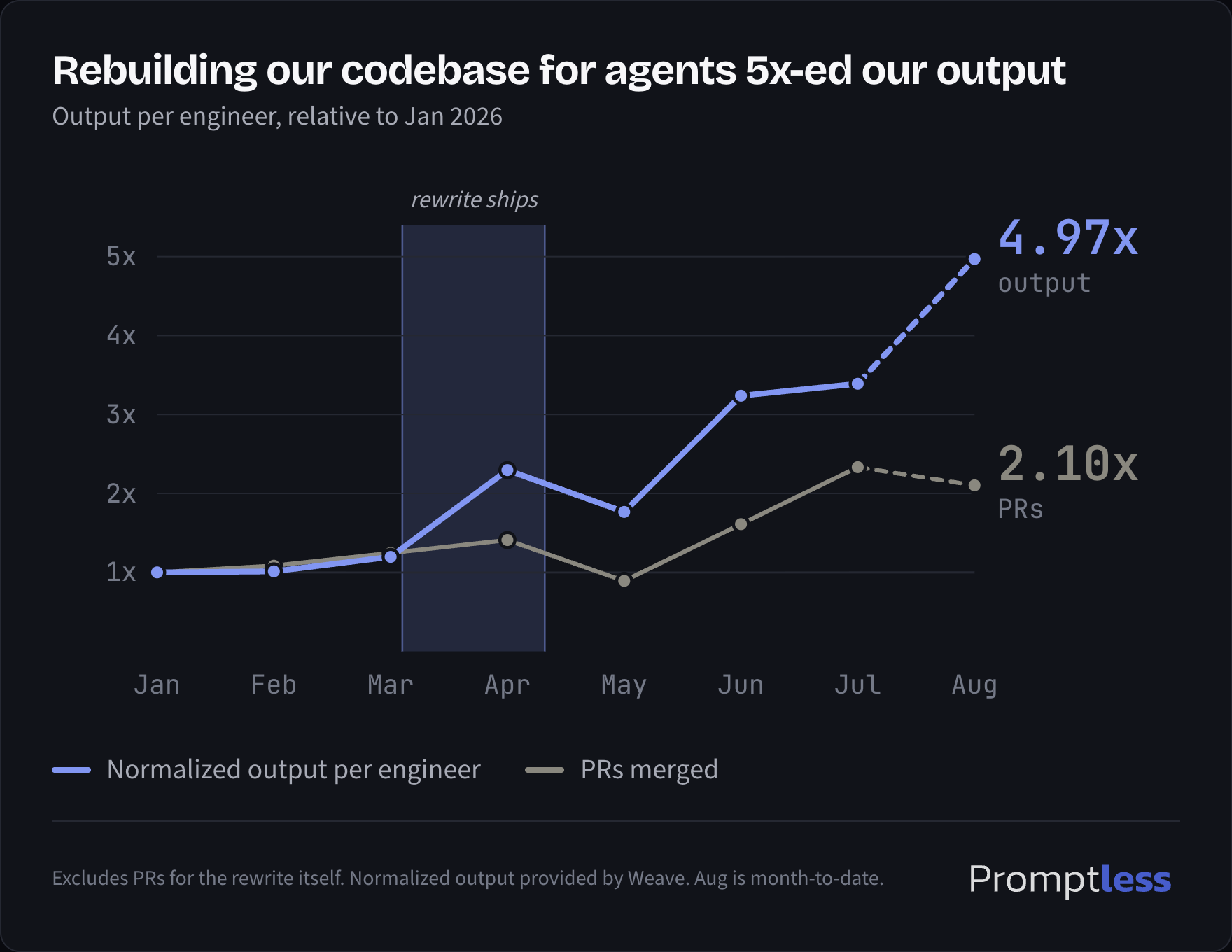
tl;dr: yes. Output per engineer went up 3-5x, without an increase in bug frequency. But we made a lot of mistakes along the way, and there were some unexpected steps needed for the payoff to actually show up.
Why we did it
Section titled “Why we did it”In February, a few things came to a head:
- On-call was brutal. 30-40% of our engineering time was spent on on-call triage and remediation, and when we were debugging, it often felt like the codebase was getting in our way.
- Our agent evals were always breaking. One of our engineers described it as “a fragile paper mache of monkey-patched code and thorns”. Evals were inherently a challenge because we had to mimic arbitrary third-party state for every integration Promptless supports, and any substantial change to our agent broke our evals.
- When we looked, the metrics on code churn were terrible. In February, 59% of the code we wrote was code we rewrote shortly after writing it. :(
- Our newest engineer asked a provocative question: “If a new YC company was going to provide the same value to users as Promptless but lap us in a week by leveraging the cutting edge of agentic development, how would they do it?”
What’s funny: our product is an agent, and we had built a habit of rearchitecting our agent every 3-6 months, recognizing that as the substrate gets more intelligent, we had to shift to an Agent Experience with fewer training wheels and more flexibility to unleash newly afforded headroom. But we hadn’t applied the same exercise to our SDLC and software principles.
But what actually makes a codebase agent-friendly? Before the rewrite, we already had a monorepo. Skills, AGENTS.md, and agent plans were already checked in, with symlinks for each harness. Agents could already spin up an isolated local environment from a fresh worktree in seconds.
The biggest gap was the actual code architecture, and it boiled down to one theme: Lean into eng design patterns meant for much larger teams. Explicit dependency contracts, layered module boundaries, mechanical enforcement, and per-domain context maps all become table stakes when your contributors are agents. I’d been at small startups for the last 10 years, so this felt very unnatural. From an engineer on the team at the time: Felt very weird doing “harness engineering” for a 5-person company. Felt less weird the moment a single Plan Mode session shipped what would’ve been a sprint of work.
How it happened
Section titled “How it happened”We decided one engineer (who formed the most detailed opinion on the new design) should drop everything else and own the rewrite full-time. The bet was that centralizing all the context in one head would make the design decisions faster and more coherent than splitting them across the team.
He’d be the first to admit we dramatically underestimated the scope. We thought we’d spend a couple of days getting agents to enumerate every requirement and user journey as Linear issues, set some architectural principles (more on those later), interrogate a plan until it was airtight, point a swarm of coding agents at the issues and let them run over a weekend, and have something to test and cut over within a week. It did not go down like that!
Here’s what happened, with some lovely quotes from the post-mortem.
- The swarm face-planted. Post-mortem: “There was too much variance in individual dev-agent output >> breaking changes and uncoordinated implementations. Reminds me of a friend’s situation in a super dysfunctional (human) eng org: multiple teams shipping rapidly into a shared codebase with no concern for cohesion or shared patterns.”
- What actually worked was much more deliberate. One dev agent driving, with a pool of about five review agents in fresh contexts poking holes in its work. The agent wouldn’t find flaws in the code it just wrote, and we needed to catch bad design and principle violations early. Ultracode makes this pattern a lot easier now. :)
- We set up a cut-over plan that allowed us to migrate each customer to the new codebase independently. There was no way we could review every line of code, every method, or even every file, so dogfooding was critical. Still, we knew we weren’t going to catch every gap before cutting over real customers, which we decided was a fine tradeoff.
- We cut over ourselves and then ramped up. We started dogfooding the new runtime on March 14 (two weeks after starting work), and cut over the final customers on March 31. We deleted the legacy codebase on April 10 (I still remember looking at that PR).
The aftermath, and the road to the payoff
Section titled “The aftermath, and the road to the payoff”For about a month after launch, we honestly weren’t sure it had been worth it. Eng output actually went down for the first month. Did we just get seduced by every engineer’s fantasy of being able to rebuild from scratch?
- It was like the whole team was onboarding to a new codebase at once (because we were). We were overly optimistic that the new architecture would be so clean it would explain itself, but it didn’t. In reality, we needed to do a lot more work socializing and getting a common understanding of the new architecture with the team.
- The agents kept forgetting the design principles. Coding agents had surprisingly bad instincts in the new codebase by default, and would happily reintroduce exactly the patterns we’d torn out. We added a
PRINCIPLES.mdfile as a design north star, which was referenced in ourAGENTS.mdand our pr-review subagent workflow. Honestly, it should have been there on day one. - We spent a lot of that month teaching the models to stay on the rails — e.g. writing skills and subagent definitions for our common workflows. This was critical to ensure that the agent didn’t slowly degrade the codebase.
Fortunately, it ended up paying off in a big way.
- Output per engineer went up 3-5x (according to Weave’s models, which benchmark engineering output across orgs). Percentile went from 58th to >90th among similar eng teams, so it wasn’t just model improvements.
- On-call went from a full-time burden to a fraction of one engineer’s attention. Those anxiety-inducing on-call hand-offs suddenly became very easy.
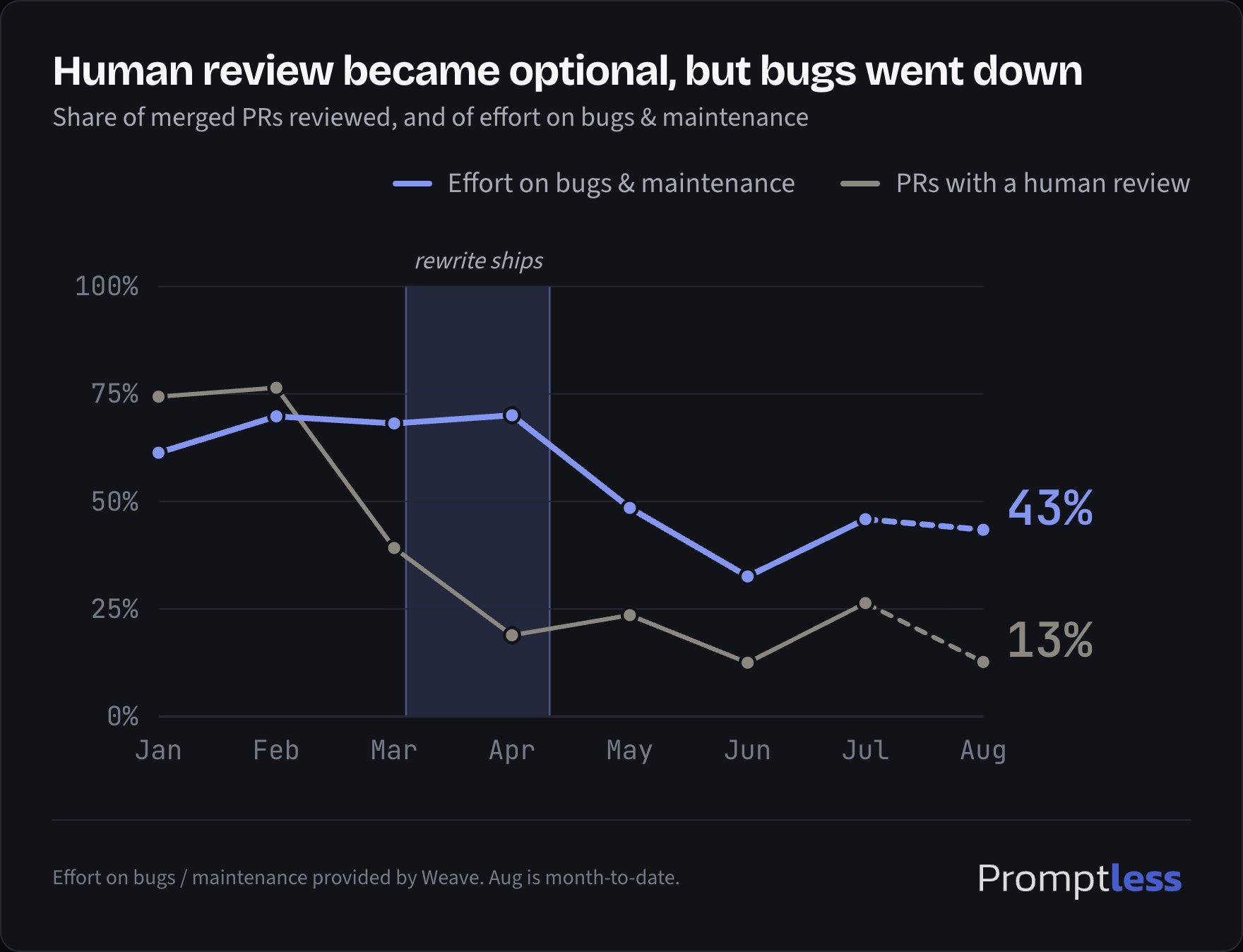
- We made human PR review optional. Coding agents could follow better patterns, our abstractions became much more testable, and review bots became much more capable, so we elected to make human review of PRs completely optional. Engineers still requested review on 10-15% of PRs, but the shift was dramatic.
- I thought I should expect more bugs because of that, but it was the opposite. In spite of eliminating mandatory human PR reviews, the proportion of time spent on bugs and maintenance work actually went down. Every report about AI adoption in engineering said the opposite should happen.
- We got comfortable biting off more ambitious work. Interestingly, the number of PRs we merged only went up about 2x, but the engineering effort per PR went up on average, meaning that with the new architecture, we could make bigger changes confidently.
If you’re thinking about doing this yourself
Section titled “If you’re thinking about doing this yourself”The line from the post-mortem I keep coming back to: “The rewrite isn’t really about code. It’s about building a shape of a system that you and a swarm of agents can both think clearly inside.”
- Bring the team in early. I still think it was the right call to centralize the implementation on one engineer’s shoulders, but good context-sharing requires progressive disclosure, and a single braindump at the end isn’t enough.
- Don’t trust coding agents’ taste. Gastown-type approaches just aren’t good enough to uncork the real issues with their system design choices. The frontier models at the time were Opus 4.6 and GPT-5.3-Codex, but I don’t think this part would be different with current generation models.
- Spend the most time interrogating the boundaries between systems. Without good guidance, the models fall flat on answering questions like “should this be a new module?” or “when’s the right time to split this dependency?”, and poor decisions at this level get amplified as models continue building on those decisions.
- Budget time for scaffolding/revising agent instructions, like skills. Even though we already had agent instructions, getting them revised to imbue agents with intuition about the new architecture was critical. If we skipped this, the gains would have decayed back to the median.
Keeping those instructions correct as the codebase moves turned out to be a real, recurring maintenance problem (enough that we ended up building a product around it, though that was a few months later). But if you go do a rewrite like this, instruction drift is what you’ll be fighting six months later.